Europe’s Supply Chain Problem Is Bigger Than China
Middle East sourcing is quietly becoming one of the most overlooked opportunities in European trade — and the data from early 2026 explains why. According to the McKinsey Global Institute’s latest regional trade update, the European Union swung from a €58 billion trade surplus to a €2.4 billion deficit in the first four months of the year, against €1.7 trillion in total extra-EU goods trade.
Two forces are behind it. On one side, rising imports from China widened the EU’s trade deficit with China, while Chinese competition intensified both at home and in third markets. On the other, EU exports to the United States fell sharply as 2025’s tariff-driven stockpiling reversed, with auto exports to the US continuing to slide under tariffs introduced the year before.
Europe isn’t standing still. Imports from ASEAN economies, Vietnam, and Malaysia have all grown at double-digit rates, as buyers look for supply chains less exposed to the US-China rivalry. That’s the diversification story most trade reports focus on: a pivot toward East and Southeast Asia.
The Part of the Story That Gets Skipped
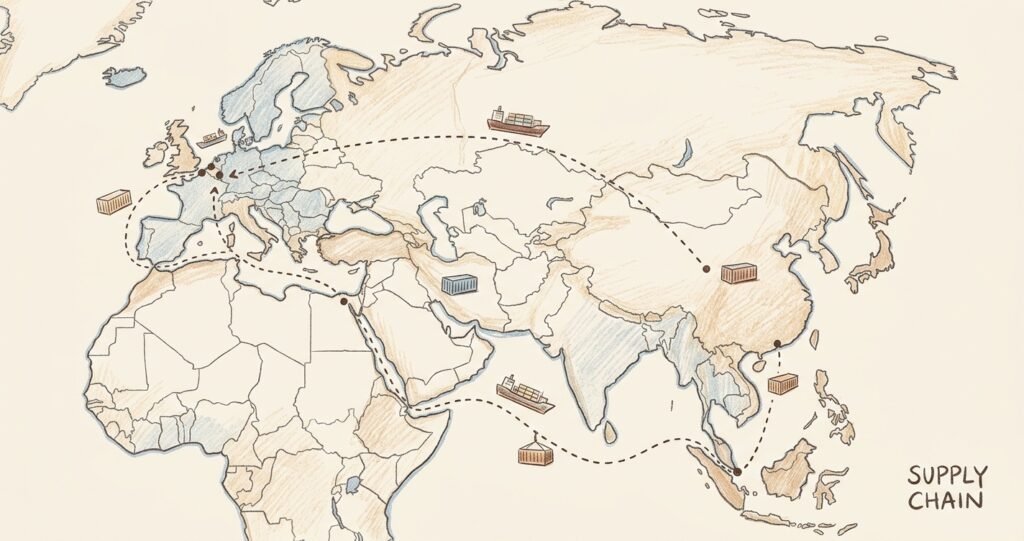
Here’s what rarely makes it into these reports: supply chain diversification doesn’t have to mean “further away.” When European buyers evaluate alternative suppliers to China, two factors actually matter most — how many different resources a region can reliably supply, and how fast and easily those goods can reach a European port.
Judged by those two criteria, Middle East sourcing is oddly absent from the conversation. It’s a region that:
- Produces across multiple categories at once — petrochemicals (urea, polymers, sulphur), construction materials (natural stone, ceramics), plastics, and agricultural products — rather than depending on a single export category
- Sits geographically closer to Europe than East Asian suppliers, which translates directly into shorter transit times and lower freight costs
- Has spare industrial capacity that, in many cases, is currently underutilized simply because European buyers haven’t built the sourcing relationships yet
Iran specifically fits this pattern closely. It has an established industrial base in petrochemicals and building materials, competitive production costs, and a shipping route to European ports that’s considerably shorter than shipments from Vietnam, Malaysia, or China. For buyers exploring how to import from Iran to Europe, the gap isn’t capacity — it’s familiarity. Most simply don’t know how to start.
Why “How to Start” Is the Real Barrier
This is usually where the conversation stalls. Sourcing from a region with sanctions complexity, unfamiliar banking channels, and different logistics norms feels riskier on paper than it needs to be in practice. The real obstacles to building a reliable Middle East supply chain are practical, not fundamental:
- Structuring compliant, risk-free financial transactions
- Quality control and inspection before goods ever leave the origin country
- Coordinating logistics from factory floor to final port of destination
- Having a single point of accountability instead of juggling multiple intermediaries
None of these are unsolvable. They’re exactly the layer a dedicated sourcing partner is supposed to remove.
Where This Leaves European Buyers
The bigger trend is clear: relying on one region for critical supply is looking riskier by the year, whether that region is China or anywhere else. The buyers who benefit most from this moment won’t be the ones waiting for the diversification conversation to catch up — they’ll be the ones who moved first toward alternative suppliers to China that others haven’t fully discovered yet.
At Tucin Argo, this is exactly the gap we work in. We connect European and international buyers directly with vetted Middle Eastern producers — managing sourcing, quality inspection, and logistics end-to-end, so the complexity of a new region doesn’t become your problem to solve alone.
Explore what we source or learn more about how it works. If you’re evaluating alternative suppliers for petrochemicals, construction materials, plastics, or food products, get in touch and tell us what you need.